
Variability – The Key to Learning

Here’s a conundrum for you. Scientists claim they have created something called “Learning Theory” that explains, of course, learning. There is a singular problem with this claim. The research used to develop this perspective doesn’t include a decent examination of behavioral variability. In case you are getting the hint already, learning is necessarily a variation on an existing repertoire or the creation of completely new behaviors. The existing repertoire allows you to “repeat” functional behaviors. Learning  requires that you temporarily abandon “repeat” and instead, do “different.” If they want to have a theory of learning, how come they don’t study “do different?” That would require a completely different research methodology. I know that because behavioral scientists have tried to study variability in an operant chamber without actually changing their methodology – ironically they are  themselves incapable of “doing different” to study “do different.” Here’s what they did do – a repeat of their existing repertoire of having an animal repeat itself endlessly with a wrinkle that barely passes as a variation.

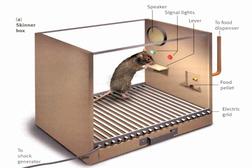
Behavior analysts studying variability took a standard “Skinner Box” and added another lever. Then they reinforced rats for pressing combinations of lever presses – usually in series of four. Left-Left-Right-Right (LLRR) would be an example of a four-press set. To create variability, they connected a specific signal to indicate that the pre-set pattern would be reinforced. Then they added a second light. If second light was on, the original pattern (LLRL) caused the machine to time-out. Any “repeat” behavior caused time-outs while new variations brought reinforcement. (LRLR, LRRR, RLLL, RLRL, etc.) Brilskinner_boxliant. With this set up you can do all kinds of analysis of variability of how often a rat does the same behavior. You can infer all kinds of things and then extrapolate your findings to publish peer-reviewed papers. Just don’t do it too much. Studies regarding variability represent a tiny fraction of actual behavior analytic research. (If you wish to see the best of the best on this topic, look up Allen Neuringer) Continue reading
Abstract from a workshop I gave at ABAI

“Punish or Perish”

This year, millions of dogs will die because of a lack of positive punishment. Their common failing is behavioral, not medical. This behavioral malady is composed of several innocuous and lethal behaviors: jumping on people, darting out the front door, destroying property and biting. Each of these behaviors can be stopped through operant means – but not if your only tool is positive reinforcement. Positive reinforcement cannot create inhibitions that will prevent an animal from offering normally occurring behaviors. Only positive punishment is capable of stopping a behavior, cold. If you wish to slow down or stop the slaughter, you must be able to skillfully punish a behavior. That presents a bigger problem. Virtually every academic institution and many professional psychological associations tacitly endorse and enforce a bias against the study or practice of positive punishment. Because of this bias, there is not a single text, course, instructor, practical examination, internship or certification that would qualify an academically trained behaviorist to use punishment safely, effectively and humanely. So, while millions of carcasses are hauled to land-fills, major institutions decry the behavioral effect that would save their lives — positive punishment. This presentation will include a robust discussion of positive punishment. This will include a summary of the rules governing the practical and effective use of positive punishment and live demonstrations of these rules on real animals.

(Note: My demo-dogs at the workshop were two Doberman males – a father/son pair. Three days prior they had ripped each other seriously in a deadly serious fight. They were festooned with stitches on their heads, necks, ears and shoulder. I had them lying side-by-side within less than five minutes. As I described details of how I solve these types of problems, they went to sleep next to each other.)

Learning Theory: Huh?

If you investigate any number of modern dog training sights, professional organizations for behavior counselors or read basic psychology texts you’ll find the term “learning theory”. Apparently, by memorizing the catechism of “learning theory” one doesn’t need to look at nature. It’s all explained, right there in the scientific research. Being a natural skeptic, I have my doubts about this assumption. Having spent over 30 years working with animal behavior at the highest levels of difficulty, I don’t buy it. I think the primary purpose of citing learning theory as the be-all, end-all of behavior is to silence people who do not have an academic background. Guess what? I don’t have an academic background but I can read scientific literature apparently better than the vast majority of learned doctors. I also have tens of thousands of hours of experience actually controlling behavior. Obviously, I am not silent. That is because once you prick the bubble of “learning theory” you realize that it’s a scam. To save time and effort I will lay it out for you. As I am not a modern behavioral scientist, I don’t expect you to believe me just on my say-so. Feel free to check my statements as much as you like. If you are objective about the topic you’ll come to the same conclusions I have. If you are biased, you’ll ignore the logic and believe what you want to believe. If it was a conversation about who is going to win the World Series we could let it ride. However, the use of “learning theory” to squelch questioning of modern behavioral therapy inevitably leads to withholding treatment known to be effective – universally considered unethical in the medical and psychological world. Continue reading

Sophie the Terrified Lab (Published in the IAACP “Safe Hands” Journal, fall, 2011.

Sophie is a real dog. I didn’t make her up as a composite of a bunch of dogs I’ve seen. She’s a four-year-old Labrador retriever. She was one of ten pups and lived exactly as they did. She wasn’t roughly handled or neglected. She wasn’t subjected to loud noises that weren’t also heard by the whole litter. She was cuddled, loved and handled as much and as little as the other pups. Her first owner was a man who wished Sophie to bond solely to him. He planned to make her a hunter. For the first months in his home, he was the only one who fed her. At about a year, she went to school to be a gun-dog. She handled everything just fine. She was trained with a remote collar and learned quickly. She wasn’t traumatized by the E-Collar and will happily do everything a flushing retriever is supposed to do. She is steady to wing and shot and won’t flush until told to do it. She gets the bird (or finds it if necessary) and makes a solid retrieve. In other words, she’s perfect in the field. That is obviously what she was bred to do. In virtually every way she’s the perfect hunter. What she isn’t, is a perfect pet. Continue reading